Parallel Editorial
Specimen
Schliemann · Ilios · 1881
A short passage moved through the studio's process — facsimile, verified transcription, rendered English, and the methodology trail. The specimen demonstrates voice and editorial register; it is not a substitute for a free audition commission produced on a text of the client's own choosing.
Source
Heinrich Schliemann, autobiographical introduction to Ilios. Stadt und Land der Trojaner, F. A. Brockhaus, Leipzig, 1881, page 1. Original German. Public domain. Digital facsimile from the Universitätsbibliothek Heidelberg (DOI: 10.11588/diglit.963).
The facsimile
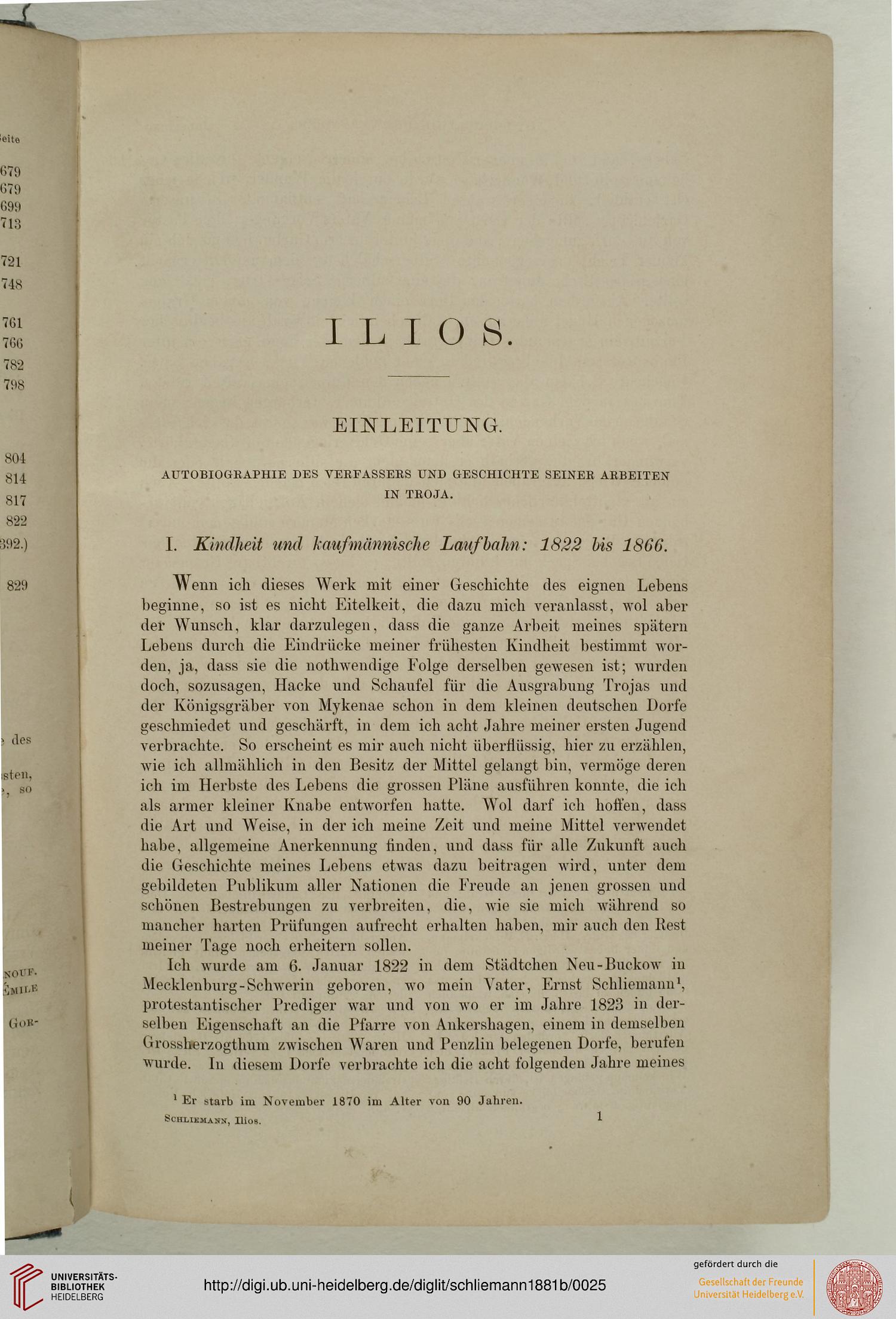
From facsimile to working text
The Heidelberg facsimile is paired with machine-generated OCR. Fraktur recognition is brittle on mid-19th-century typography, and a clean working text requires verifying every line against the image. On this single page the OCR introduced the following errors, each corrected against the facsimile:
- gesehmiedet → geschmiedet — Fraktur sch ligature misread as seh
- Eolge → Folge — initial F misread as E
- Grossherzogthuni → Grossherzogthum — terminal m misread as ni
- Penzliu → Penzlin — terminal n misread as u
- dein → dem — terminal m misread as in
Period spellings retained without modernization: spätern (modern späteren), nothwendige (modern notwendige), wol (modern wohl), grossen (modern großen). These are not errors but the orthography of pre-reform German. Modernizing them would silently re-edit the source.
The verified passage
Ilios.
Einleitung.
Autobiographie des Verfassers und Geschichte seiner Arbeiten in Troja.
I. Kindheit und kaufmännische Laufbahn: 1822 bis 1866.
Wenn ich dieses Werk mit einer Geschichte des eignen Lebens beginne, so ist es nicht Eitelkeit, die dazu mich veranlasst, wol aber der Wunsch, klar darzulegen, dass die ganze Arbeit meines spätern Lebens durch die Eindrücke meiner frühesten Kindheit bestimmt worden, ja, dass sie die nothwendige Folge derselben gewesen ist; wurden doch, sozusagen, Hacke und Schaufel für die Ausgrabung Trojas und der Königsgräber von Mykenae schon in dem kleinen deutschen Dorfe geschmiedet und geschärft, in dem ich acht Jahre meiner ersten Jugend verbrachte. So erscheint es mir auch nicht überflüssig, hier zu erzählen, wie ich allmählich in den Besitz der Mittel gelangt bin, vermöge deren ich im Herbste des Lebens die grossen Pläne ausführen konnte, die ich als armer kleiner Knabe entworfen hatte. Wol darf ich hoffen, dass die Art und Weise, in der ich meine Zeit und meine Mittel verwendet habe, allgemeine Anerkennung finden, und dass für alle Zukunft auch die Geschichte meines Lebens etwas dazu beitragen wird, unter dem gebildeten Publikum aller Nationen die Freude an jenen grossen und schönen Bestrebungen zu verbreiten, die, wie sie mich während so mancher harten Prüfungen aufrecht erhalten haben, mir auch den Rest meiner Tage noch erheitern sollen.
Schliemann, Ilios. Stadt und Land der Trojaner, F. A. Brockhaus, Leipzig, 1881, p. 1.
Rendered English
Ilios.
Introduction.
Autobiography of the Author and History of his Works at Troy.
I. Childhood and Mercantile Career: 1822 to 1866.
If I begin this work with a history of my own life, it is not vanity that prompts me thereto, but rather the wish clearly to set forth that the whole labour of my later life has been determined by the impressions of my earliest childhood — nay, that it has been the necessary consequence of them; for, so to speak, the pickaxe and spade for the excavation of Troy and the royal tombs of Mycenae were already forged and sharpened in the little German village in which I passed eight years of my first youth. Thus it appears to me not superfluous to recount here how I gradually came into possession of the means by virtue of which, in the autumn of life, I was able to carry out the great plans I had formed as a poor little boy. Well may I hope that the manner in which I have employed my time and my means will meet with general approbation, and that the history of my life will also, for all time to come, contribute something toward diffusing, among the cultivated public of all nations, a delight in those great and beautiful endeavours which, as they have sustained me through so many hard trials, shall yet gladden the remainder of my days.
Translated from Schliemann, Ilios. Stadt und Land der Trojaner, F. A. Brockhaus, Leipzig, 1881, p. 1. Consolidated through the studio's multi-model pipeline.
Schliemann's own English (1880 comparator)
The 1880 Murray edition of Ilios contains a parallel autobiographical preface that Schliemann himself produced or supervised — Schliemann's own working English, not an independent translation. It is a comparator, not a source: the studio's pipeline does not translate from it. Set beside the rendering above, it shows where Schliemann's own English softens the German rhetorical structure under publication and audience pressure.
Ilios.
Autobiography of the Author.
John Murray, London · Harper & Brothers, New York, 1880.
If I begin this book with my autobiography, it is not from any feeling of vanity, but from a desire to show how the work of my later life has been the natural consequence of the impressions I received in my earliest childhood; and that, so to say, the pickaxe and spade for the excavation of Troy and the royal tombs of Mycenae were both forged and sharpened in the little German village in which I passed eight years of my earliest childhood. I also find it necessary to relate how I obtained the means which enabled me, in the autumn of my life, to realize the great projects I formed when I was a poor little boy. But I flatter myself that the manner in which I have employed my time, as well as the use I have made of my wealth, will meet with general approbation, and that my autobiography may aid in diffusing among the intelligent public of all countries a taste for those high and noble studies, which have sustained my courage during the hard trials of my life, and which will sweeten the days yet left me to live.
Schliemann (supervised), Ilios: The City and Country of the Trojans, John Murray, London / Harper & Brothers, New York, 1880, p. 1.
Semantic precision. Dieses Werk (this work, in the elevated sense of a lifetime's labour) becomes this book — a deflation. Nothwendige Folge, the philosophical "necessary consequence," becomes natural consequence, softening Schliemann's deterministic claim about his childhood into something more mundane. Both substitutions trade authorial weight for Victorian readability.
Temporal distinction. The German makes a clear distinction between frühesten Kindheit (earliest childhood) and ersten Jugend (first youth) — separate biographical phases on either side of a developmental boundary. The 1880 English collapses both into a single earliest childhood, losing the progression that matters in a biographical text tracing the formation of a mind over time.
Syntax and emphasis. The German ja in bestimmt worden, ja, dass sie... is a rhetorical intensifier — the 19th-century pivot from statement to insistence. Rendering it as nay preserves that flourish; the 1880 and flattens the sentence's energy. Likewise prompts me thereto preserves the structure of dazu mich veranlasst faithfully; the 1880 from any feeling of vanity adds words the German does not have.
The studio's rendering preserves what Schliemann's own English deflates — the right outcome for a scholarly edition translating his German prose, rather than reproducing his self-presentation in English.
Methodology trail (excerpt)
The full consolidation log accompanies the rendering as a structural deliverable, not an appendix. It documents every consequential decision against the source. What follows is an excerpt.
On terminology. Three locked decisions departed from majority convergence in the pipeline and warrant surfacing here. Cultivated (rather than educated) for gebildet, because Bildung in 19th-century German denotes humanistic cultivation, not schooling. Diffusing (rather than spreading) for verbreiten, because the period English for the dispersion of taste and sentiment is diffusing. Beautiful (rather than noble) for schönen, because the German is aesthetic, not moral, and rendering it as noble would substitute a moral register the source does not warrant.
On structure. Schliemann opens the autobiography with a long compound-subordinate sentence that resolves through three semicolon-linked clauses. The consolidated English preserves the period structure rather than breaking it into shorter modern sentences. The "fluent paraphrase" failure mode — where the smoother the English, the more aggressively it has flattened the source — is most visible at exactly the point where translators are most tempted to simplify.
On Schliemann's own English. The 1880 Murray edition of Ilios contains a parallel autobiographical preface that Schliemann himself produced or supervised. It is a comparator, not a source. Schliemann's English systematically simplifies and substitutes — natural for necessary, intelligent for cultivated, sweeten for gladden — in ways that reveal his self-presentational priorities for an English-language audience. The studio is translating Schliemann's German prose, not reproducing his own English self-image.
On the pipeline. The studio's methodology uses an evolving combination of frontier AI models — a minimum of four for any commission, scaled up to eight where source complexity, period vocabulary, or paleographic ambiguity warrants additional convergence. The roster is not fixed; specific models enter and leave the rotation as their performance on the studio's evaluation set shifts. For this specimen, four models — Claude, ChatGPT, Gemini, and Grok — produced parallel renderings, which a human editor then consolidated, locking each consequential decision against the source and the comparator. AI was production infrastructure for the work; it was not the editor. This disclosure accompanies the rendering as a methodology principle.
Why this passage
The opening of Schliemann's autobiography is the most-cited paragraph in his published writing. Any reader familiar with 19th-century archaeology will recognize it on sight, which means the studio's rendering will be evaluated against translations already in the literature — a feature, not a hazard. The voice is also distinctively challenging: Schliemann pivots between rhetorical flourish and declarative restraint, with period syntax that resists fluent paraphrase. A passage difficult to translate cleanly is the most honest test of methodology.